
THE SHORT VERSION
Use a small, observable first build as your baseline. Expansion is easier to diagnose when you know what was working before.
The steps below are editorial suggestions to test in your own save.
1. Read the situation before you pave
Start with the scenario's own objectives and tutorial. A first build that answers the current objective is a better learning exercise than copying a huge end-game layout from a different map.
Take a moment to identify the part of the map you want to serve, the connection you will use, and the land you can actually build on. Keep enough room to revise an entrance or service area without rebuilding everything.
- Note your scenario and the game version before following a guide.
- Identify one specific goal for this first build.
- Make a save before an expensive or hard-to-reverse experiment.
2. Follow one complete journey
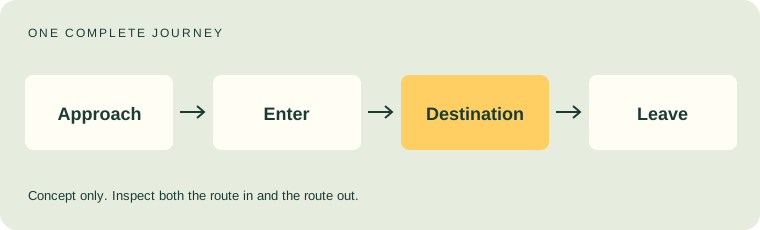
Our suggested first test is deliberately small: watch a vehicle approach your site, enter, reach its destination and leave. Trace the whole journey instead of judging the layout from the number of spaces drawn on the map.
If the first few trips stall, stop adding capacity. Look closely at the point where movement changes. A small layout makes a disconnected segment or crowded join easier to notice.
3. Give yourself a baseline
Before changing prices, roads and services together, write down what you can observe: whether arrivals finish their trips, where queues begin, and which warning or unmet need is visible. Compare the same observations after each change.
There is no supported universal starting price or exact profit target in this guide. Treat precise numbers from an older version as a hypothesis until you reproduce them in your own scenario.
- Change one thing at a time.
- Compare a similar stretch of game time before and after.
- Keep the change only if the symptom improves without creating another.
4. Expand the part that is actually limiting you
When a small setup works, add the next piece with a clear reason. Is the problem a queue, missing service, supply interruption or simply not enough room? Those are different questions, and paving more land may answer only one of them.
Check newly unlocked options before committing to a large construction plan. Leave room for the services and routes you may need next. Repeat the journey test after every meaningful expansion.
A first-session workflow you can follow
Use these stages in order, returning to an earlier stage whenever a trip stops working. They describe what to inspect, not exact menus, prices or construction dimensions; follow the tutorial for those details.
- Stage 1 — Read the objective and save. Write down what the scenario currently asks you to achieve and which construction options are unlocked.
- Stage 2 — Build the smallest setup the tutorial allows. Keep space around its access connection so you can adjust it later.
- Stage 3 — Observe an arrival, its destination and its departure. If any part stalls, diagnose that part before adding another district.
- Stage 4 — Inspect the needs currently displayed. Pick one repeated warning, check its matching service and watch a customer use it.
- Stage 5 — Record a baseline: the first queue location, any supply warning and the visible trend you want to improve.
- Stage 6 — Make one targeted change. Watch comparable activity, check the whole journey again, and keep or revert the change.
- Stage 7 — Expand only after the first system works. Repeat stages 3–6 for the expanded site.
If the first build stalls, choose one investigation
Do not treat every disappointing result as a capacity problem. Match what you can actually see to a smaller investigation.
- Vehicles wait at entry → observe the vehicle at the front, then inspect the route beyond it. Begin with the traffic guide.
- A station stays empty → inspect upstream supply, then follow a delivery. Begin with the gasoline guide.
- A need remains unmet → read the specific feedback and follow one customer to the matching service. Begin with the visitor-needs guide.
- Visits complete but finances disappoint → record the visible income and costs before changing anything. Keep price experiments separate from construction; this guide does not establish a profitable price.
READY FOR THE NEXT CHANGE?
Your quick checklist
Tick these off while you inspect your save. Checks are temporary.
Sources & limits
- Car Park Capital · official Steam store page ↗Official release information · reviewed 2026-10-11
Early Access release date, developer, publisher, launch scenarios and announced plans. Future plans are not guarantees.
Guide updated 12 Oct 2026. Source review dates appear above. Pre-release descriptions can change. These suggestions have not been tested in a played save. Full editorial policy.